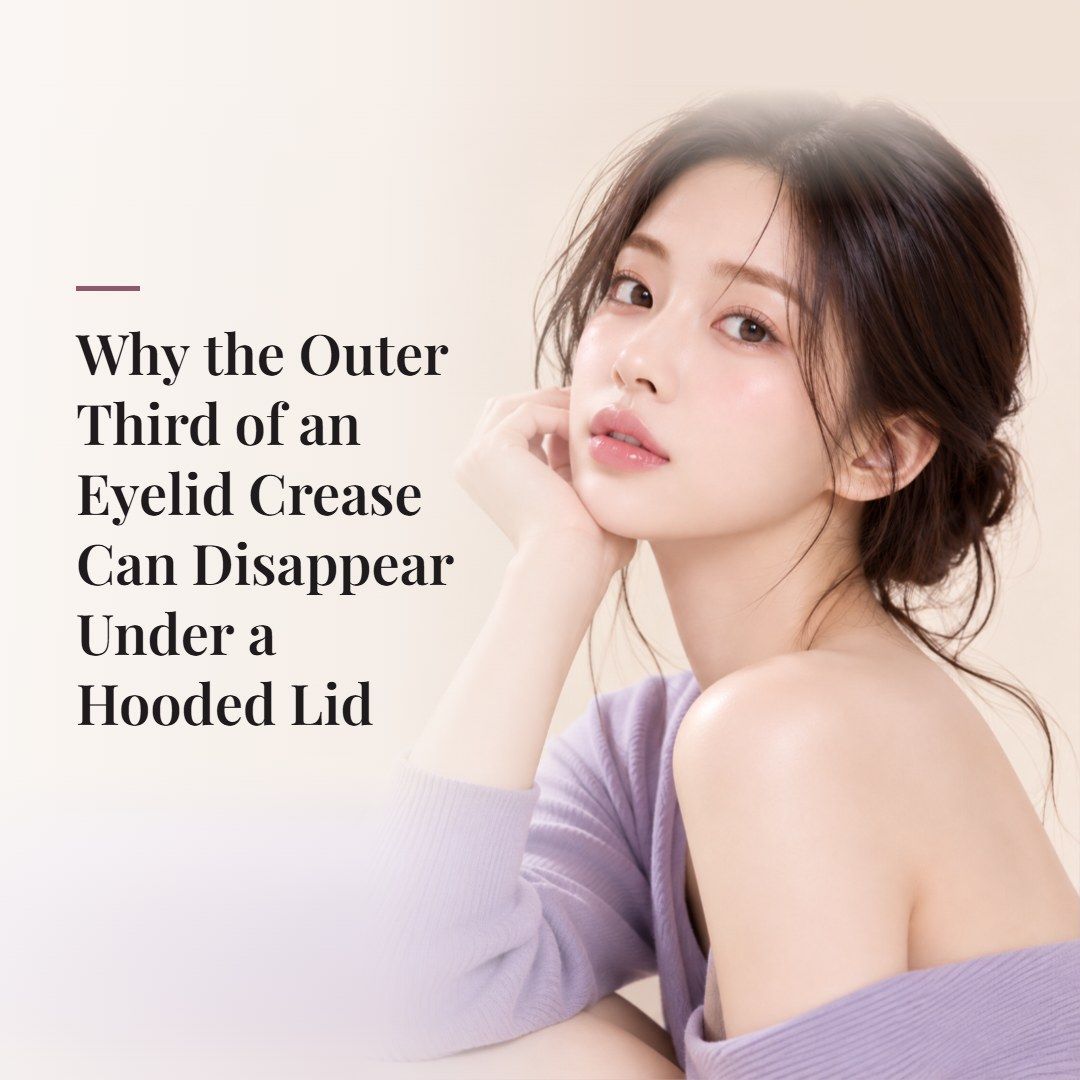
Many people notice that their double eyelid crease looks clear near the inner and middle portions of the eye, but fades or vanishes completely toward the outer corner. This is especially common with age and in people who have heavy brows or extra skin at the side of the upper lid. The outer third of the crease is the part most affected by hooding, and understanding why helps determine whether the solution lies in the eyelid itself, the brow, or a combination of both.
What Hooding Looks Like at the Outer Corner
Lateral hooding usually shows up in a few recognisable ways:
- Skin drapes over the outer part of the crease, making it disappear
- The outer corner of the eye looks heavier or droopier than the inner corner
- Eye makeup smudges or transfers onto the upper lid near the outer edge
- The eye can look tired or sad even when you feel rested
These signs often develop gradually, so many people only notice them when comparing older photos.
Why the Outer Third Is Most Vulnerable
The outer portion of the upper eyelid has less support than the inner portion. The brow tail is also more prone to descending with age, because fewer muscles hold it upward. As the brow tail drops, it pushes skin and soft tissue down onto the outer lid. At the same time, skin elasticity decreases. The combination of brow descent and loosening skin causes the outer crease to be covered first, even when the inner part still looks well defined.
Eyelid Skin vs Brow Descent
Identifying the main cause is the key to the right treatment:
- Excess eyelid skin: if the brow sits in a normal position but skin overhangs the crease, the problem is mainly in the eyelid.
- Brow descent: if lifting the brow tail with a finger makes the outer crease reappear, the brow is contributing significantly.
- Both: many people have a mixture, which is why a combined assessment is important.
Treatment Options Within the Eyelid
When skin excess is the main issue, upper blepharoplasty can remove redundant skin and re-establish a clear crease. The incision is placed within the crease and may extend slightly toward the outer corner to manage lateral skin. A careful design avoids removing too much skin, which could make it difficult to close the eyes or create an unnatural, high fold. For some patients, a partial incision or crease refixation may be enough if skin excess is mild.
Treatment Options at the Brow
If the brow tail is low, eyelid surgery alone may not restore the outer crease for long:
- Temporal brow lift: lifts the outer brow through incisions hidden in the hairline.
- Sub-brow lift: removes skin just below the brow, popular for lateral excess in Asian eyelids.
- Browpexy: provides mild support to the brow tail through the eyelid incision.
Lifting the brow first can also mean less eyelid skin needs to be removed.
Why Removing More Skin Is Not Always the Answer
It can seem logical to remove extra skin at the outer corner, but if the brow is the main cause this can pull the brow even lower and create a heavy, tired look. Over-resection may also make the crease appear unnaturally long or create tension that pulls the outer corner downward. Treating the underlying cause usually produces a more natural and longer-lasting result than simply trimming more skin from the eyelid.
Planning your schedule around recovery is equally important. Most people need several days of rest followed by a period when swelling is still visible, so it is wise to avoid booking important events, travel or photographs too soon afterwards. Building in extra time allows healing to progress naturally without pressure to judge the result early.
What Recovery Looks Like
Recovery depends on the procedure chosen:
- Upper blepharoplasty: swelling peaks in the first few days, with stitches removed after about a week.
- Brow lift procedures: may involve more swelling around the temples or brow.
- Combined procedures: recovery takes slightly longer but addresses both causes in one stage.
The outer crease usually becomes visible again once swelling has settled over several weeks.
Key Points to Discuss With Your Surgeon
Ask whether your outer hooding is caused mainly by skin, brow descent or both, and what happens when your brow is lifted gently by hand. Ask whether eyelid surgery alone will last, or whether brow support would give a better result.
- The outer crease disappears first because it has the least support.
- A lifting test helps separate eyelid skin excess from brow descent.
- Removing more skin is not always the best solution.
- Combining eyelid and brow treatment can give a more balanced outcome.
With the right diagnosis, the outer part of the crease can be restored in a way that looks natural and lasts.
Every eyelid is different, and general information like this cannot replace an in-person examination. Measurements, photographs and a careful discussion of your goals allow a surgeon to explain which options are realistic for your anatomy, what the recovery will involve, and how the result is likely to change over time. Taking the time to understand these details before deciding is one of the most reliable ways to achieve a natural, lasting outcome.