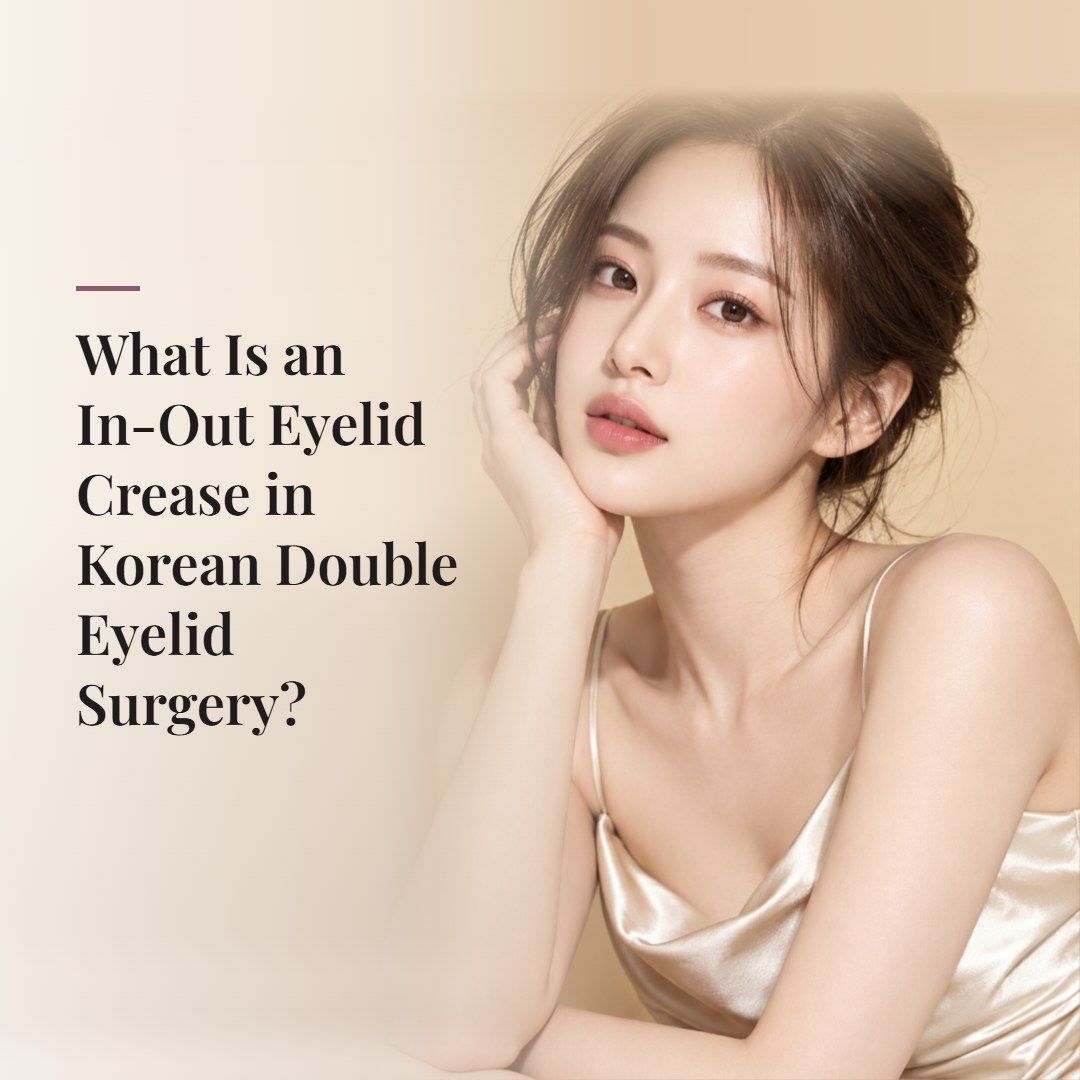
Most people hear about two double eyelid shapes: tapered and parallel. In practice, many Korean surgeons use a third option that sits between them, often called an in-out crease. It begins tucked inside the inner corner like a tapered crease, then gradually lifts away from the lashes so that the middle and outer sections look closer to a parallel line. Understanding how this hybrid works can help you describe your goals more precisely and judge whether it suits your eye shape.
How an In-Out Crease Is Shaped
The name describes how the line travels across the lid:
- "In" at the inner corner: the crease starts beneath or just at the edge of the epicanthal fold, so the inner corner keeps a soft, natural look.
- "Out" across the middle: the line separates from the fold and becomes visible as it moves outward.
- Gentle widening at the outer third: the crease reaches its widest point near the outer corner without flaring dramatically.
Because the line changes direction gradually, the transition point between the "in" and "out" sections is one of the most carefully planned details of the design.
Why Surgeons Use This Design
A hybrid crease solves a common dilemma. A fully tapered line can look too subtle for some patients, while a fully parallel line may look forced when the inner corner is covered by skin. The in-out design gives a brighter, more open look through the centre of the eye while respecting the natural fold. Many patients describe it as looking "awake" rather than "done," which is why it is frequently chosen for first-time procedures. It also tends to age gracefully, because the inner portion stays protected by the natural fold while the outer portion keeps the eye looking open as skin gradually loosens.
Who Tends to Suit an In-Out Crease
This shape often works well for people with:
- A mild to moderate epicanthal fold
- Medium upper eyelid skin thickness
- Eyes that look tired in the middle but not heavy at the inner corner
- A preference for definition that still looks natural in photos and in person
People with very thick skin or significant hooding may need additional skin or fat management for the crease to hold its shape.
Planning the Height of the Line
Height matters as much as shape. A crease that is designed too high can look surprised or create a deep groove, while one that is too low can be swallowed by overlying skin. Surgeons usually mark the crease with the eyes closed, then check it with the eyes open and looking straight ahead. Small differences of one millimetre can change the final look, so the design is often adjusted several times during consultation. Surgeons also consider how much skin will hang over the crease once the eye is open, since this "show" above the lashes determines how visible the fold really is in daily life.
Incisional vs Non-Incisional Methods
An in-out crease can be created with different techniques:
- Buried-suture methods: suitable for thin skin and minimal fat; shorter recovery but the crease can relax over time.
- Partial-incision methods: a small opening allows limited fat removal with a moderate recovery.
- Full-incision methods: best for thicker skin, excess fat or revision cases, with the most durable fixation.
The technique is chosen for stability, not just for downtime.
What the Crease Looks Like During Healing
Early swelling almost always makes the crease look higher and more parallel than planned. In the first two weeks, the "in" part at the inner corner may not be visible at all. As swelling settles over one to three months, the line usually returns to its designed path and the inner portion tucks back in. Patients are encouraged to compare photos at set intervals rather than judging the result day by day. Mild asymmetry is also normal during this stage, as each eyelid swells and settles at a slightly different pace.
Questions to Ask at Your Consultation
A focused set of questions makes the design discussion much easier:
- Where exactly will my crease start, and how will it relate to my inner fold?
- How high will the line sit at its widest point?
- Which technique gives the most stable result for my skin and fat?
- Can you simulate the in-out crease so I can see it in a mirror?
- How different will it look at one week, one month and six months?
Bringing a few reference photos of creases you like, along with photos of results you want to avoid, often helps the conversation more than any single technical term.
Is an In-Out Crease Right for You?
The best crease shape is the one that matches your anatomy and the expression you want, not the one that is trending. An in-out design can be an excellent compromise for people who want more visible definition than a tapered crease without the artificial look a forced parallel line can create. A careful simulation, honest discussion of skin and fat, and realistic expectations about swelling are the foundations of a result that looks natural for years.
Because eyelid surgery involves very small measurements, even minor differences in anatomy can change which approach is most suitable. Reading about the options is a useful first step, but the most important information comes from an examination of your own eyes, a clear explanation of the risks and benefits, and time to compare your choices calmly before committing to surgery.